
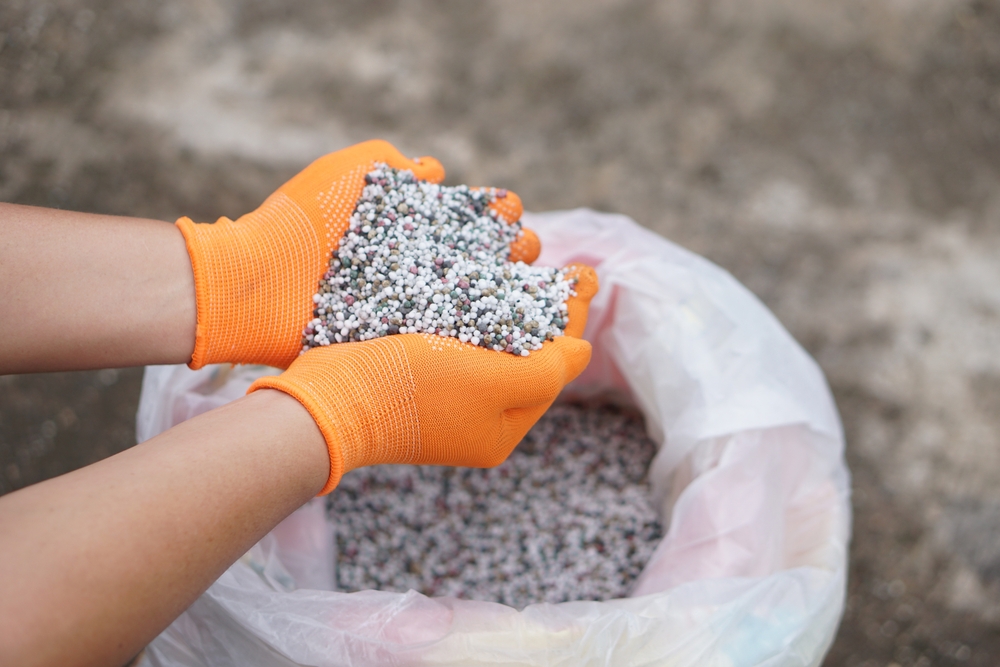
If you’ve shopped for lawn fertilizer lately, you’ve probably seen a 4-step fertilizer program promising to take care of your lawn from spring through fall. Four bags, four applications; follow the calendar and supposedly you’re done. It sounds smart and convenient. The problem is that most Utah lawns don’t actually need a 4-step fertilizer program at all, and these products aren’t typically formulated for your local soil and climate conditions in mind. That matters here in Utah, where grass has to deal with dry air, intense summer heat, limited water and plenty of thick, compacted clay soil.
While a multi-step fertilizer plan can be useful for certain soil conditions, it’s not usually necessary here. Generally nitrogen and phosphorous are the most important nutrients year-round for lawns. Potassium and other micronutrients are commonly found naturally in Utah soils and aren’t necessarily needed in a fertilizer program. So a multi-step fertilizer often results in unnecessary cost, complication, waste, overtreatment, and a whole lot of partially used fertilizer bags taking up space without actually contributing much to your lawn.
For many Utah homeowners, a simpler all-season lawn fertilizer gives you more flexibility, saves money and storage space, and typically contains all that’s needed for a healthy lawn.
What Is a 4-Step Fertilizer Program?
Most 4-step fertilizer programs divide the growing season into four different products.
Step 1: Early Spring
Usually combines fertilizer with a crabgrass pre-emergent to encourage spring green-up while preventing certain weeds.
Step 2: Late Spring
Typically combines another feeding with broadleaf weed control.
Step 3: Summer
Adds another round of fertilizer, sometimes with iron or insect control depending on the product.
Step 4: Fall
Finishes the season with a “winterizer” designed to feed the lawn before dormancy.
4-Step Fertilizer Pros and Cons
| Pros | Cons |
| Gives beginners an easy schedule to follow | Uses a one-size-fits-all calendar instead of responding to your lawn’s actual needs |
| Widely available at big-box stores | May combine fertilizer and weed control when you only need one |
| Makes it easy to remember applications | Encourages feeding during periods when Utah grass may already be heat-stressed |
| Packages several lawn-care products together | Requires buying and storing several different products |
| Can produce quick visible green-up | Can encourage unnecessary top growth instead of focusing on long-term lawn resilience |
The biggest concern for Utah lawns is that more fertilizer is not always better.
Most Utah lawns use cool-season grasses such as Kentucky Bluegrass and Tall Fescue. During the hottest part of summer, their growth naturally slows. Utah State University Extension specifically notes that midsummer fertilizer applications are generally discouraged for cool-season turf unless the lawn receives heavy use. Too much fertilizer during this period can encourage excessive top growth and make grass more vulnerable to drought stress.
In other words, if your lawn is already trying to survive a 98-degree July afternoon, forcing it to grow faster probably isn’t doing it any favors.
Why 4-Step Fertilizer Can Be a Bad Fit for Utah
Utah lawns already have enough working against them. Our summers are hot and dry. Water disappears quickly. Many yards sit on dense clay soils that compact easily and can make it harder for water, air and nutrients to move into the root zone. A rigid 4-step fertilizer schedule doesn’t account for any of that.
It also often ties weed control directly to fertilization. But more often than not, your lawn doesn’t need herbicide. A few weeds are better treated by pulling (versus treating your full lawn unnecessarily with chemicals). It’s best to apply herbicides only when you have an abundance of weeds and spot treatment no longer makes sense.
All-Season Fertilizer Keeps Things Much Simpler
Instead of buying a different fertilizer for every part of the year, an all-season formula lets you use one blend throughout the growing season and adjust your timing based on your grass, weather and conditions.
BioGrass All Season Lawn Fertilizer uses a slow-release coating that provides controlled nutrient absorption over several weeks rather than creating one big burst of growth. One 5-gallon bucket covers 11,200 square feet, or enough for four applications on a lawn of roughly 2,500 square feet.
And this is an important distinction: “all season” does not mean you fertilize once per year. It means you can use the same fertilizer for your seasonal applications instead of buying a different numbered “step” every time. If you get a soil test and see your soil is deficient in phosphorous, potassium, or other micronutrients, it makes more sense to do a one-time application to correct this, rather than a full fertilizer program that could overtreat the issue.
How to Use All-Season Lawn Fertilizer
Keep it simple:
- Apply the fertilizer evenly with a broadcast spreader according to the product directions, preferably when temperatures are cooler and the lawn is dry.
- Water the lawn after applying so nutrients can move into the soil and root zone.
- Reapply during the growing season, typically every 4-6 weeks, skipping July through mid-August.
If your lawn is already stressed during extreme summer heat, that may be a good reason to wait rather than push another flush of growth. Slow-release fertilizer is also the preferred option when fertilizer is needed during hotter periods. For more details on application, see our complete Lawn Fertilizer Guide.
A Better Utah Lawn Starts Before the Fertilizer
Fertilizer can help a lawn perform better, but it can’t turn the wrong grass into the right grass. If you’re installing a new lawn in Utah, start with grass that was actually selected to handle Utah conditions. Buying locally grown or regionally adapted sod and grass seed gives your lawn a much better starting point than choosing a generic variety that was never intended for our heat, drought and soil conditions. BioGrass offers several natural turfgrass varieties developed for the Intermountain West, including drought-resilient options designed specifically for Utah landscapes.
From there, focus on the basics: improve compacted soil when needed, water deeply rather than constantly sprinkling the surface, mow at a healthy height and avoid pushing unnecessary growth when your lawn is already stressed.
Give Your Lawn What It Needs, Not Four Different Bags
Lawn care doesn’t really need to be that complicated.
While a 4-step fertilizer program makes a nice display in the garden center, Utah lawns don’t grow according to a national marketing schedule – and these fertilizers can lead to unnecessary, wasteful application of nutrients that your Utah lawn doesn’t actually need. Good watering practices, quality fertilizer, and attention to your microclimate and lawn needs makes the best plan for a healthy lawn year-round. Using products specifically formulated for Utah’s soil and climate is also key, which you won’t find in the big box fertilizers.
With BioGrass All Season Lawn Fertilizer, you can keep one slow-release fertilizer on hand, apply it when your lawn actually needs it and skip the parade of different bags. Less guessing, less clutter in the garage and a lawn-care plan that makes a lot more sense for Utah.